
New SpaCe report examines how space ambitions become national capability
A new report from SpaCe – Aarhus Space Centre compares space governance in six European coun-tries and asks what governments need to put in place to turn political ambitions into lasting capa-bilities.
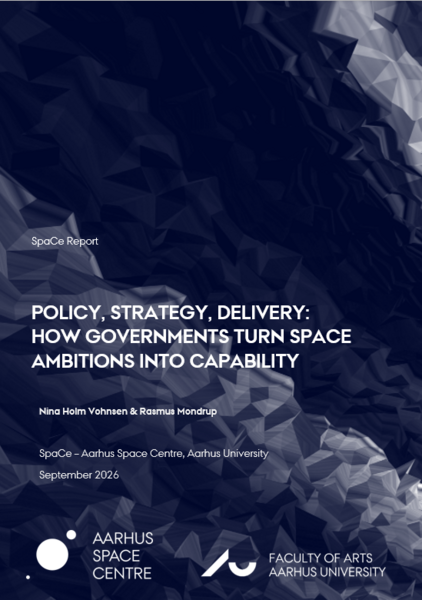
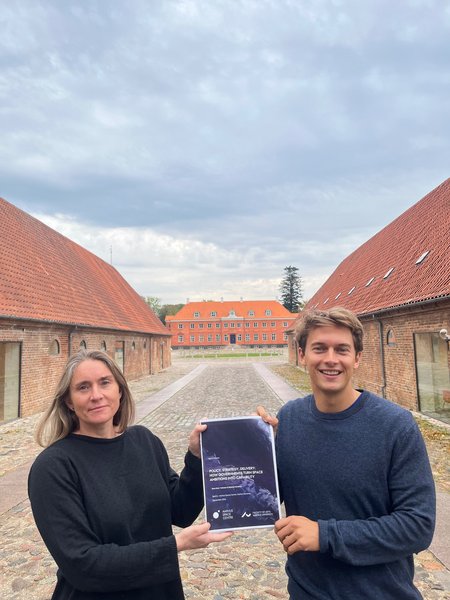
Should Denmark establish a national space agency? The question is often raised as space becomes increasingly important to research, industry, critical infrastructure and defence. In the report Policy, strategy, delivery: how governments turn space ambitions into capability, Nina Holm Vohnsen and Rasmus Mondrup suggest beginning with a more practical question: Which problems must Denmark’s space governance solve, and do the institutions responsible have the authority and resources to solve them?
Six countries, different arrangements
The report examines the United Kingdom, Luxembourg, Sweden, Poland, Finland and Norway. Each has organised the relationship between political aims, strategic priorities and implementation differently. The comparison shows why an institutional name alone says little about what a country can deliver. Mandates, budgets, access to decision-making and coordination across government all matter.
The country studies make those differences concrete. The United Kingdom established a space agency partly to give civil space activities clearer budget authority, then brought it into a government department when the distance between policy and delivery became a different concern. Luxembourg has aligned legislation, investment and education around space as a means of economic development. In Norway, state-owned companies operate parts of the country’s strategic space infrastructure, while a government directorate advises and coordinates.
The report also points to the importance of time. Denmark’s strategy for space research and innovation sets a direction towards 2035, while the funding arrangements used to implement it operate over shorter periods. For companies and research environments, building capability depends partly on whether investments can be planned and sustained over time.
What public investment leaves behind
The report also asks what governments gain when they invest in space under pressure. A purchase may meet an immediate need, but the way it is planned can also determine whether expertise, infrastructure and industrial capacity develop alongside it. As the authors write, governments should know “which forms of dependence they are choosing before procurement decisions choose for them.”
This question becomes particularly relevant as more space capabilities are acquired through defence budgets. The report distinguishes between three dimensions of sovereign capability. Operational sovereignty concerns control over tasking – what a system is directed to do – as well as its data, access and use. Infrastructural sovereignty concerns control over the facilities that support space activities, such as spaceports, testing equipment and ground stations. Industrial sovereignty concerns the ability to design, manufacture, maintain, modify and replace the underlying systems. A procurement decision may strengthen one of these dimensions without strengthening the others.
The “industrial middle”
Nina Holm Vohnsen and Rasmus Mondrup also draw attention to what they call the “industrial middle”: established companies with proven technologies and customers that have grown beyond the start-up stage but cannot yet compete at the scale of the largest suppliers. The report asks how public investment might help such companies grow, while still meeting urgent needs.
These companies can fall between forms of support. Innovation programmes help new ideas and start-ups emerge, while large procurement programmes tend to favour suppliers already able to deliver at scale. The authors argue that decisions made during the current period of increased public spending will affect whether that industrial middle has an opportunity to grow.
A question of public capability
For the authors, lasting capability also depends on what governments themselves are able to do: understand the sector they are making decisions about, coordinate across ministries, bring different forms of expertise together and connect investment decisions to wider public needs. Space technologies and infrastructure can serve purposes beyond the immediate reason for which they were acquired, but recognising those possibilities requires coordination when priorities and purchasing decisions are made.
The authors do not propose a particular governance model for Denmark. Instead, they offer a framework for examining how policy, strategy and delivery connect in practice. Contributions from people working across the Danish space ecosystem show how those questions look from different positions in the sector.