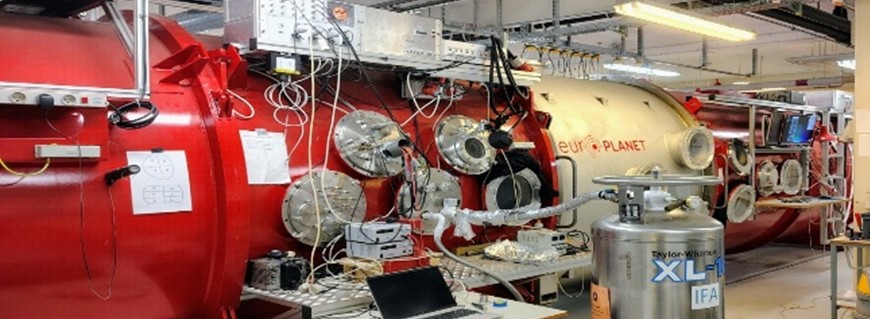
Planetology is broadly the study of environments within our solar system, including planets, moons, asteroids, comets and even general aspects of our own planet. This working group aims to coordinate and encourage collaboration between (multi-disciplinary) groups within the Aarhus Space Center having common interests in these extreme environments/bodies. This could include educational/student activities, research projects or technology development. Importantly this may include access to experimental infrastructures and methods.
The multidisciplinary nature of this WG creates an ideal environment for the exchange of knowledge across disciplinary borders and to foster novel research ideas. Access to unique laboratory facilities (in other institutes) and using state of the art technologies exposes students to the forefront of scientific advancement in space research and cannot fail to lead to new and potentially ground breaking discoveries.
Specific examples are listed below including various cross disciplinary Experimental Bachelor/Masters projects.
Several faculty members are actively involved in the Aarhus Planetary Science Working Group. Please feel free to reach out to any of the members for more information or potential collaboration within their respective areas of expertise.
| People involved | Involved in |
|---|---|
| Christoffer Karoff (karoff@geo.au.dk) | Student project ‘Lunar impact study’ simulating meteorite impact craters on the moon and studying their morphology and structure. Also involved in the DISCO Programme |
| Julian Priest (jucp@itu.dk) | DISCO program is a DanIsh Student Cubesat program, designing, building and operating small satellites |
| Ulrich Doll (ud@mpe.au.dk) | student project ‘prototype thruster’ developing and testing a novel thruster for small satellites. Teaching course: Fluid Dynamics course at MPE. |
| Sergio Ioppolo (s.ioppolo@phys.au.dk) | ‘Planetary’ ices projects (and chamber); studying Ice Surface Astrophysics |
| Liv Hornekær (liv@phys.au.dk) | InterCat Center |
| Tina Santl-Temkiv (temkiv@bio.au.dk) | Bio-wind tunnel ‘aeolian/aerosol study’ studying wind driven aerosol generation from soil |
| Kai Finster (kai.finster@bio.au.dk) | |
| Keld Rasmussen (geolkrr@geo.au.dk) | Student projects: “Aeolian transport” |
| Jon Merrison (merrison@phys.au.dk) | |
| Simon Albrecht (albrecht@phys.au.dk) | Teaching course: Space Missions and Space Technology |
| Henrik B. Pedersen (hbp@phys.au.dk) | Aerosols / Vapour pressure studies |
| Aurelien Dantan (dantan@phys.au.dk) | |
| Merete Bilde (bilde@chem.au.dk) | Aerosol studies |
| Niels Bering (nbo@ecos.au.dk) | Hydrodynamic sensor calibration |
| Infrastructure / Method | Description | Responsible |
|---|---|---|
| Planetary Environment Facilities | Large chamber AWTSII, small chamber AWTSI, boundary layer wind tunnel, flume | Jon Merrison, Keld Rasmussen, Jens Jacob Iversen (jji@phys.au.dk) |
| ASTRID II and Center for Interstellar Catalysis | Laboratory for Astrochemistry and Reactions on Surfaces | Sergio Ioppolo (s.ioppolo@phys.au.dk) |
| TVAC Chamber (DISCO) | Under construction, a thermal vacuum chamber for cubesat testing | Christoffer Karoff (karoff@geo.au.dk) |
| Clean Room (Space applications) | A dust free environment for cubesat assembly | Christoffer Karoff (karoff@geo.au.dk) |