
Space, security and society: A conversation with political science students
Who will shape the future of space, and who is responsible for what happens there? These questions brought space technology, security and international treaties into the discussion at Faglig Dag for political science students at Aarhus University.
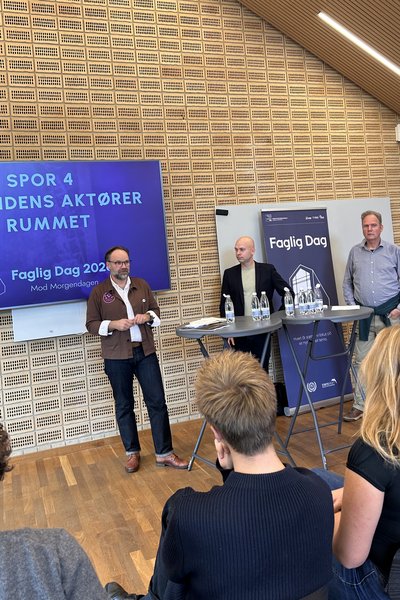
On 15 September 2026, Karsten Bubber Outzen, business developer with ESA BIC and Kitchen Space and a member of the steering committee of SpaCe – Aarhus Space Centre, joined the panel for the session Fremtidens aktører i rummet (The future actors in space).
The panel also included Poul Funder Larsen, Eastern Europe analyst and editorial writer at Jyllands-Posten, and Jakob Clod Asmund, military analyst at the Danish Defence Academy and major in the Royal Danish Air Force. Jakob Tolstrup, professor at Aarhus University’s Department of Political Science, moderated the discussion.
In his introduction, Bubber described how ESA BIC supports entrepreneurs developing businesses based on satellite data and space technology, as well as companies creating technology intended for use in space. These approaches illustrated the commercial opportunities in the space sector, including how space technology can lead to new products and services on Earth.
The panel explored space’s growing importance for defence and for infrastructure on which societies depend. Technologies that serve civilian purposes may also have military applications, while the increasing number of objects in orbit creates new challenges for monitoring activity in space. The discussion also considered the growing role of commercial companies and the possibility of purchasing space-based services rather than owning the systems that provide them.
International treaties and national legislation were another theme. The moderator raised the question of how private actors can be held accountable, and the panel discussed the responsibilities of countries that authorise space activities.
The students asked who owns space, what will happen when the International Space Station is retired, and why interest in the Moon has grown again. The space station prompted questions about the future of international cooperation, while the Moon opened a discussion about exploration and what we hope to learn there.
The many raised hands suggested that, like the universe itself, the conversation could have gone on forever.