
Space, security and the next generation of space professionals
At this year’s Folkemødet, SpaCe – Aarhus Space Centre took part in a panel conversation on the growing importance of space for society, research and national security.

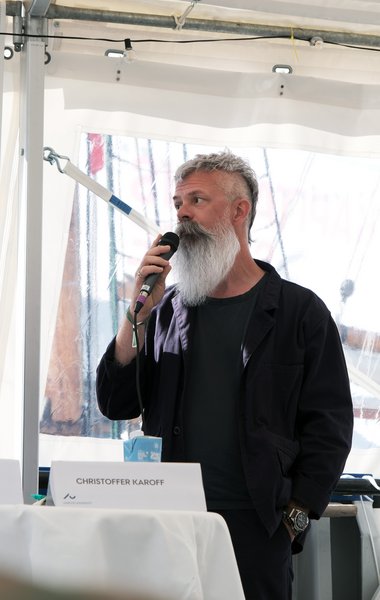
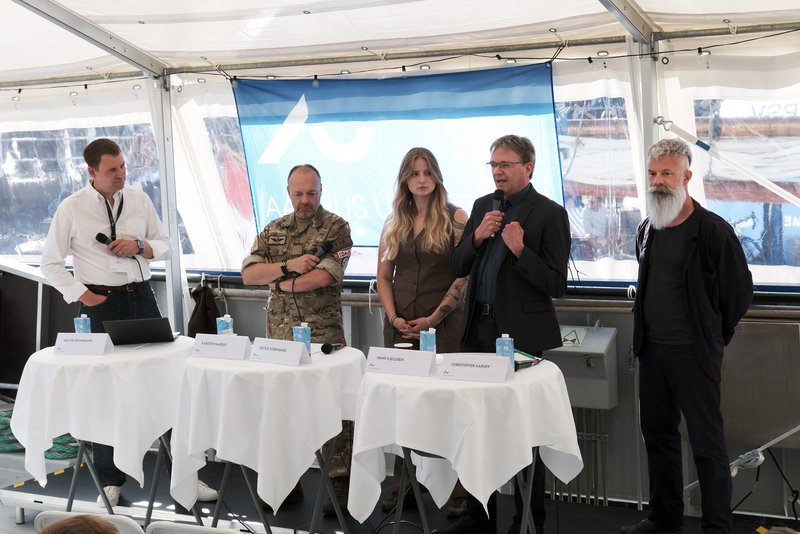
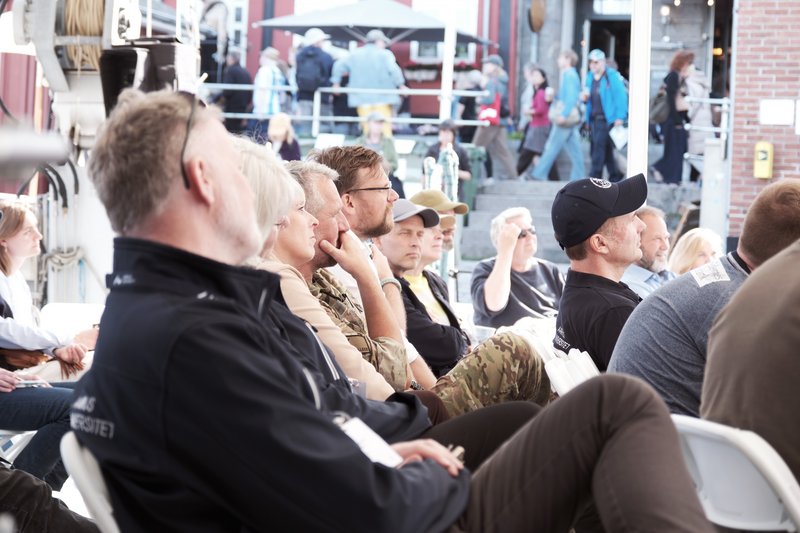
Under the title “When space also becomes a matter of security”, the event brought together perspectives from research, defence, innovation and education. The conversation was moderated by Malthe Sommerand, journalist at Weekendavisen, and featured Cecilie Strømsnes, physics student at Aarhus University; Karsten Marrup, Major and Head of the Centre for Air and Space Operations at the Royal Danish Defence College; Hans Kjeldsen, Professor at the Department of Physics and Astronomy and Director of SpaCe – Aarhus Space Centre; and Christoffer Karoff, Associate Professor at the Department of Geoscience and AU Distinguished Senior Innovator.
A central theme was the value of giving students hands-on responsibility for real space missions. Cecilie Strømsnes contributed the student perspective and reflected on what it means to be involved in satellite construction and mission management.
Taking part in a real mission gives students experience that goes beyond what can be learned from textbooks alone. It develops technical expertise, collaboration skills, confidence and a deeper understanding of the many decisions and responsibilities involved in bringing a satellite mission from concept to orbit. Such experience is also important for preparing students for future careers in the growing space sector.
The conversation also placed current developments in a broader historical perspective. Space exploration has evolved through several distinct phases: from observing the universe from Earth in the time of Tycho Brahe, through the space race of the 1960s and the Space Shuttle era, to today’s landscape, in which commercial actors play an increasingly important role in the exploration and use of space.
This development has changed both who operates in space and how space-based technologies are used. Satellites are no longer relevant only to scientific research or major state-led programmes. They are now deeply integrated into modern society and support services that many people rely on every day.
The panel also addressed the role of space in defence and security. Alongside land, sea, air and cyber, space is increasingly regarded as a fifth operational domain. Both civilian society and defence depend heavily on data and services provided by satellites.
GPS is one familiar example, but satellite infrastructure also supports communication, navigation, monitoring and the collection of data used across a wide range of sectors. This growing dependence means that access to reliable space-based services has become an important part of both civilian resilience and national security.
Universities and astrophysics research have an important role to play in this changing landscape. Methods originally developed to study the universe may gain new relevance as the number of satellites and other objects in orbit grows, commercial activity expands, and space becomes increasingly important to national and international security.
Research environments can contribute knowledge, methods and technologies that help society understand, monitor and operate in an increasingly complex space environment. At the same time, close links between research, education, innovation and operational experience are essential for building the skills and capabilities needed in the years ahead.
The conversation at Folkemødet demonstrated how closely connected these questions have become. Space research, student education, commercial innovation, critical infrastructure and security are no longer separate topics. Together, they form part of a rapidly developing field in which Denmark and Danish universities have an important role to play.