
What can a 75-gram meteorite tell us about the early Solar System?
Researchers from Aarhus University have published the first detailed microanalytical study of the Dueodde meteorite – Denmark’s 8th known meteorite. The findings provide new insight into material and processes dating back to the early history of the Solar System.
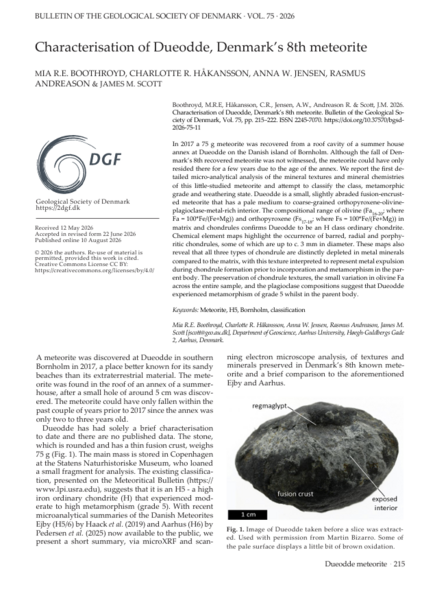
In 2017, a 75-gram meteorite was discovered in the roof cavity of a summer house annex at Dueodde on the Danish island of Bornholm. Now, researchers from the Department of Geoscience at Aarhus University have carried out the first detailed analysis of its mineral textures and chemistry.
The study confirms that the Dueodde meteorite is an H5 ordinary chondrite – a high-iron stony meteorite that experienced a moderate degree of metamorphism within its parent body.
Using micro-X-ray fluorescence and scanning electron microscopy, the researchers examined the minerals and small rounded structures known as chondrules preserved inside the meteorite. The analyses show that these chondrules are distinctly depleted in metal compared with the surrounding material.
According to the researchers, this texture likely reflects processes that took place while the chondrules were still molten in the solar nebula, before they became incorporated into the meteorite’s parent body. Despite later metamorphism, Dueodde therefore still preserves geological evidence of processes from the very early Solar System.
The new data also make it possible to compare Dueodde with the Danish meteorites Ejby and Aarhus, which are also H-chondrites. Together, these meteorites contribute to a better understanding of the geological history of their parent material.
The study was carried out by Mia R.E. Boothroyd, Charlotte R. Håkansson, Anna W. Jensen, Rasmus Andreason and James M. Scott from the Department of Geoscience at Aarhus University.
The article, “Characterisation of Dueodde, Denmark’s 8th meteorite,” was published online on 10 August 2026 in the Bulletin of the Geological Society of Denmark.
Find the full article here