
What do we lose when the night sky grows brighter?
A live episode of RumSnak during Aarhus Festuge brought Professor Hans Kjeldsen together with hosts Tina Ibsen and Anders Høeg Nissen to discuss light pollution, astronomy and the value of a dark night sky.

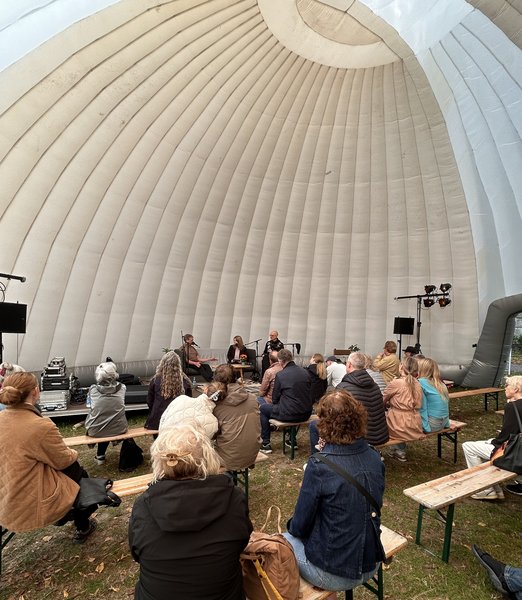
What does it mean when the Milky Way can no longer be seen from where we live? How does artificial light affect astronomical research? And can we bring darker skies back while keeping the lighting we need? These questions are at the heart of a live episode of RumSnak, recorded during Aarhus Festival in front of an audience in Kuplen.
Professor Hans Kjeldsen from Aarhus University joined Tina Ibsen and Anders Høeg Nissen for a conversation about light pollution and the value of darkness. Hans explains that as artificial light brightens the night sky, its contrast fades. The Milky Way is among the first sights to disappear. Faint shooting stars and the northern lights also become harder to see. For someone who has never stood beneath a truly dark sky, it can be difficult to imagine what is missing.
One of the topics discussed is what we lose beyond the view itself. Darkness is part of the natural environment for people and wildlife, while seeing the stars can shape our sense of place in the Universe. The conversation also considers whether darker skies should be possible near where people live, as well as in designated Dark Sky areas.
For astronomers, the effects of light pollution are measurable. A brighter sky adds noise to telescope observations, making faint, distant objects harder to study. Hans explains why processing an image afterwards cannot always recover the information that was lost. The discussion also covers the growing number of satellites. Their trails can cross telescope images, while the increase in background light presents a different and more difficult challenge. Even observatories in remote locations, such as those in Chile, depend on decisions about lighting and new infrastructure around them.
What can be done to protect the night sky? Switching off light that is not needed has an immediate effect, and directing outdoor lighting where it is needed can also help. Through the European Darker Sky project, SpaCe is involved in work to reduce light pollution for the benefit of astronomy, people and wildlife.
The live recording took place on 6 September, ahead of Seeing Stars, when lights were switched off across part of central Aarhus later that evening.