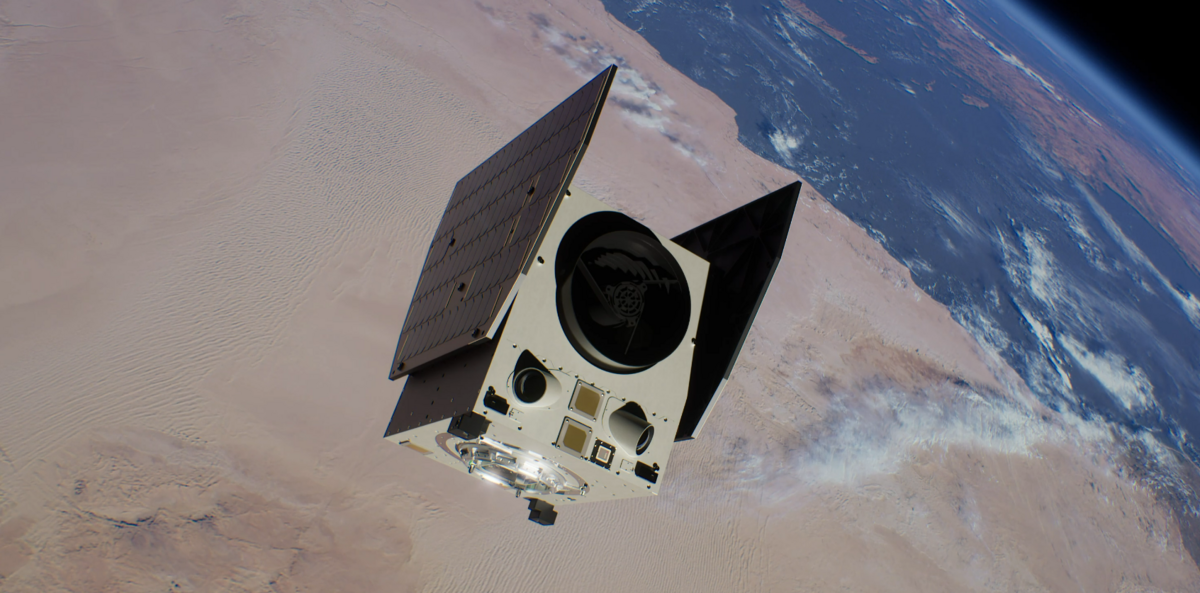
STEP is based on the Micro-8 platform by Space Inventor, allowing high accuracy guidance, navigation and control of the spacecraft. Using reaction wheels, the satellite will re-orient itself multiple times per orbit to capture one or more astronomical targets with its main science instrument.
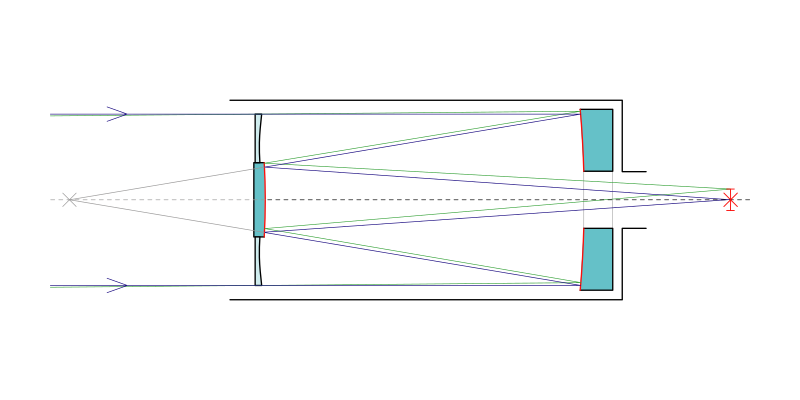
Light from distant astronomical objects is collected via the Cassegrain telescope as seen on the front of the spacecraft. This telescope has a diameter of 250mm and focuses light onto the detector according to the principle sketched in the illustration below. The focal length of the telescope is 1525 mm.
STEP is a mission focusing only on the ultraviolet region of the electromagnetic spectrum, blocking out the light in what we consider the visible colors. For this reason, the telescope is equipped with a number of filters and coatings to achieve light throughput only in the near-UV.
The light from the telescope is focused onto a low-noise Electron-Multiplying Charged Coupled Device (EM-CCD). This detector uses a special technique to read out the collected light in which each released photo-electron is multiplied in a high-voltage potential. With this, the effect of Read-Out Noise (RON) is effectively eliminated, removing the noise penalty of splitting an observation into multiple exposures. For this reason, STEP will take many short exposures and combine them on-the-fly to provide a high quality image.
Collectively, the telescope, filter and detector make up the photometric science instrument of STEP, with the following parameters:
| Aperture | 250 | mm |
| Focal Length | 1525 | mm |
| Focal Ratio | f/6.1 | |
| FOV | 30 x 30 | arc minutes |
| Resolution | 1024 x 1024 | pixels |
| Image Scale | 1.76 | arcsec / pixel |
At a later stage, more thorough performance characteristics of the instrument will be released for evaluation.